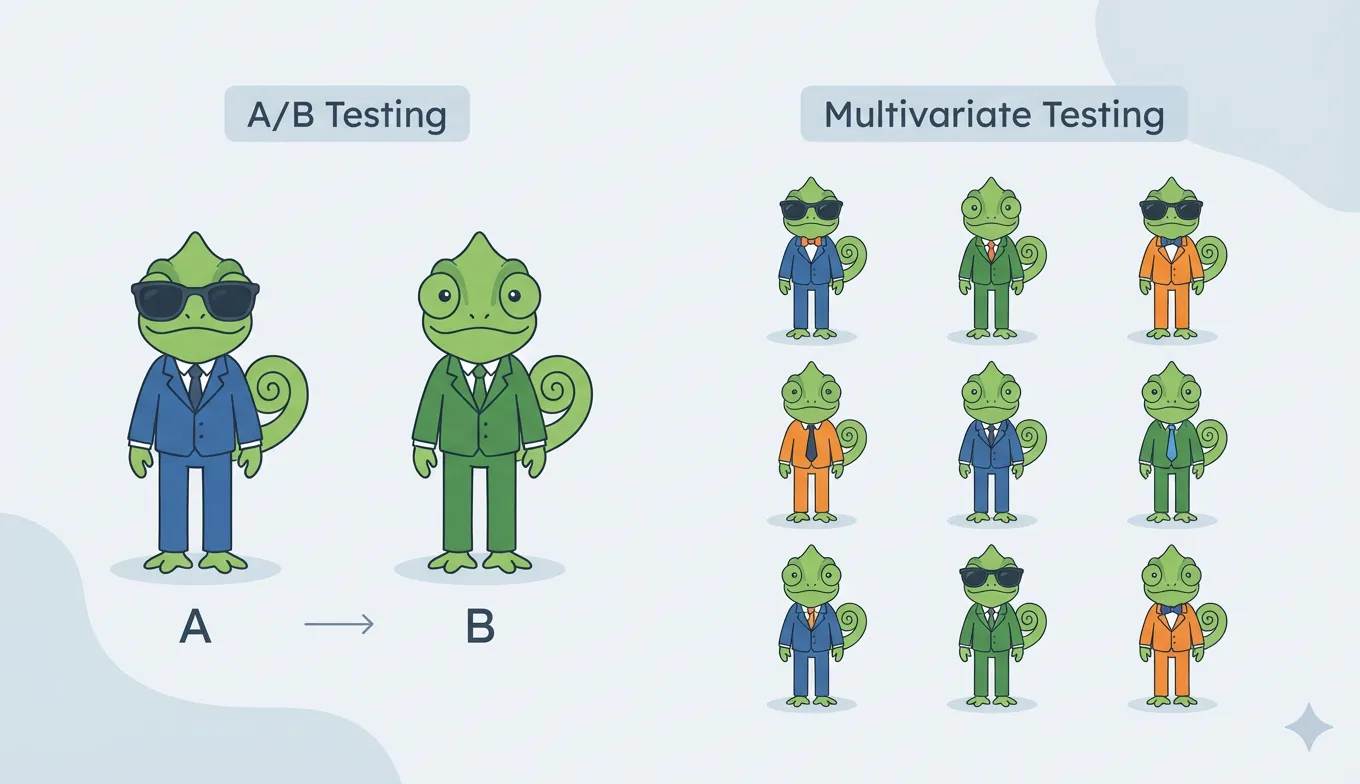
A/B testing compares two page versions to find a winner. Multivariate testing compares multiple elements simultaneously to find the best combination. Choose A/B testing if you have under 50,000 monthly visitors or want quick results. Choose multivariate testing when you have high traffic and need to understand how elements interact.
Most businesses should start with A/B testing—it's simpler, faster, and works with less traffic. Here's how to decide which method fits your situation.
What Is A/B Testing?
A/B testing (also called split testing) shows two different versions of a webpage to different visitors. Half see version A (your current page), half see version B (your variation). After collecting enough data, you compare conversion rates and pick the winner.
The key constraint: you test one change at a time. If you're testing a new headline, only the headline differs between versions. This isolation makes results easy to interpret—if version B wins, the headline caused it.
A/B testing works well for:
- Testing major layout changes
- Comparing entirely different designs
- Sites with limited traffic (1,000+ monthly visitors minimum)
- Teams new to conversion optimization
What Is Multivariate Testing?
Multivariate testing (MVT) tests multiple page elements and their combinations simultaneously. Instead of testing one headline against another, you might test two headlines, two hero images, and two button colors—all at once.
The math multiplies quickly. Two variations of three elements creates eight possible combinations (2 × 2 × 2 = 8). Each combination needs enough visitors to reach statistical significance, which is why MVT requires substantially more traffic than A/B testing.
The advantage? MVT reveals interaction effects—how elements work together. According to Nielsen Norman Group, sequential A/B tests might miss the optimal combination entirely because they can't measure how a headline performs differently with different images.
Key Differences at a Glance
| Factor | A/B Testing | Multivariate Testing |
|---|---|---|
| Variables tested | 1 (two versions) | Multiple elements, all combinations |
| Minimum traffic | ~1,000 visitors/month | ~50,000 visitors/month |
| Time to results | 2-4 weeks typically | 4-8 weeks or longer |
| Complexity | Simple to set up and interpret | Requires careful planning |
| Best for | Major changes, redesigns | Optimizing existing pages |
| Insight type | "Which version wins?" | "Which elements matter most?" |
When to Use A/B Testing
You Have Limited Traffic
A/B testing works with modest traffic because you're only splitting visitors between two versions. You need roughly 1,000 visitors per variation to reach statistical significance—so 2,000 visitors total for a basic test.
Multivariate testing with the same three-element example requires 8,000 visitors minimum (1,000 per combination). If your page gets 10,000 monthly visitors, an A/B test might conclude in two weeks while an MVT could take two months.
Rule of thumb: If your testing page gets under 50,000 monthly visitors, stick with A/B testing.
You're Testing Major Changes
When you're comparing a complete redesign against your current page, A/B testing is the right choice. MVT is designed for incremental improvements, not radical overhauls.
As Optimizely notes, "If your goal is to move towards a substantial redesign, an A/B test comparing the new design against the current one is more appropriate than multivariate testing."
You Need Quick Answers
Startups, product launches, and time-sensitive campaigns often can't wait months for test results. A/B testing delivers reliable data faster because you're measuring fewer variations.
When to Use Multivariate Testing
You Have High Traffic Volume
MVT becomes practical when your testing page receives 50,000+ monthly visitors. At that volume, even complex tests with many combinations can reach significance within a reasonable timeframe.
Adobe recommends using their Traffic Estimator before launching any MVT: "If you do not have sufficient traffic, reduce the number of combinations or increase the test duration."
You Want to Understand Element Interactions
This is MVT's superpower. A/B testing tells you version B beat version A—but not why. MVT reveals which specific elements drive conversions and how they interact.
Consider this scenario: you A/B test a new headline and it wins. Then you A/B test a new image and it also wins. But what if the winning headline actually performs worse with the winning image? Sequential A/B tests can't detect this. MVT can.
According to VWO, HawkHost ran a multivariate test on combinations of hero images, subheadings, and CTAs. One specific combination produced a 204% increase in sales—an interaction effect they'd likely have missed with sequential A/B tests.
You're Optimizing, Not Redesigning
MVT excels at fine-tuning pages that already perform reasonably well. Once you've used A/B testing to validate your overall layout and messaging, MVT helps squeeze additional conversions from element-level improvements.
Traffic Requirements Compared
Let's make the math concrete.
A/B test example:
- Testing: New headline vs. current headline
- Variations: 2
- Minimum visitors needed: ~2,000 total
- At 10,000 monthly visitors: ~1 week to complete
Multivariate test example:
- Testing: 2 headlines × 2 images × 2 buttons
- Combinations: 8
- Minimum visitors needed: ~8,000 total
- At 10,000 monthly visitors: ~4 weeks to complete
Complex MVT example:
- Testing: 3 headlines × 3 images × 2 buttons
- Combinations: 18
- Minimum visitors needed: ~18,000 total
- At 10,000 monthly visitors: ~8 weeks to complete
The traffic requirement grows exponentially with MVT complexity. This is why most testing experts recommend limiting MVT to 2-3 elements with 2 variations each.
Can You Use Both? The Smart Approach
The best testing programs use both methods strategically.
Start with A/B testing to make big decisions: overall page layout, primary messaging, core value proposition. These tests work even with limited traffic and answer fundamental questions about what resonates with your audience. (New to A/B testing? See our step-by-step guide.)
Graduate to MVT once you have a winning foundation and sufficient traffic. Use it to optimize the details—headline variations, image choices, button text—and discover which combinations perform best together.
Think of it as a funnel: A/B testing validates your direction, then MVT maximizes your results.
Quick Decision Framework
Use this simple logic to choose your testing method:
- Does your page get under 50,000 monthly visitors? → A/B testing
- Are you testing a major redesign or new layout? → A/B testing
- Do you need results within 2-3 weeks? → A/B testing
- Do you have 50,000+ monthly visitors AND want to optimize specific elements? → Multivariate testing
- Do you need to understand how elements interact? → Multivariate testing
When in doubt, start with A/B testing. You can always graduate to MVT later.
Frequently Asked Questions
Is multivariate testing better than A/B testing?
Neither method is inherently better—they serve different purposes. A/B testing is simpler, faster, and works with less traffic. MVT reveals deeper insights about element interactions but requires substantial traffic. Most businesses get better ROI starting with A/B testing and adding MVT later.
How much traffic do I need for multivariate testing?
Plan for at least 1,000 visitors per combination. A test with 8 combinations needs 8,000 visitors minimum. For practical test durations (4-6 weeks), aim for 50,000+ monthly visitors to your testing page. Use a sample size calculator before launching.
Can I run A/B and multivariate tests simultaneously?
Yes, but not on the same page. Running both tests on one page would contaminate your results. You can run an A/B test on your homepage while running MVT on a landing page—just ensure each page has only one active test.
The Bottom Line
A/B testing and multivariate testing both improve conversions, but they're built for different situations. A/B testing is your everyday tool—simple, fast, and effective with modest traffic. Multivariate testing is specialized equipment for high-traffic optimization work.
Start with A/B testing. Learn what resonates with your audience. Build traffic. Then consider MVT when you're ready to optimize at a granular level. Looking for a tool to get started? Check out our Google Optimize alternatives guide.
Ready to run your first test? SplitChameleon makes A/B testing simple—set up your first experiment in minutes with our visual editor. Try it free.